
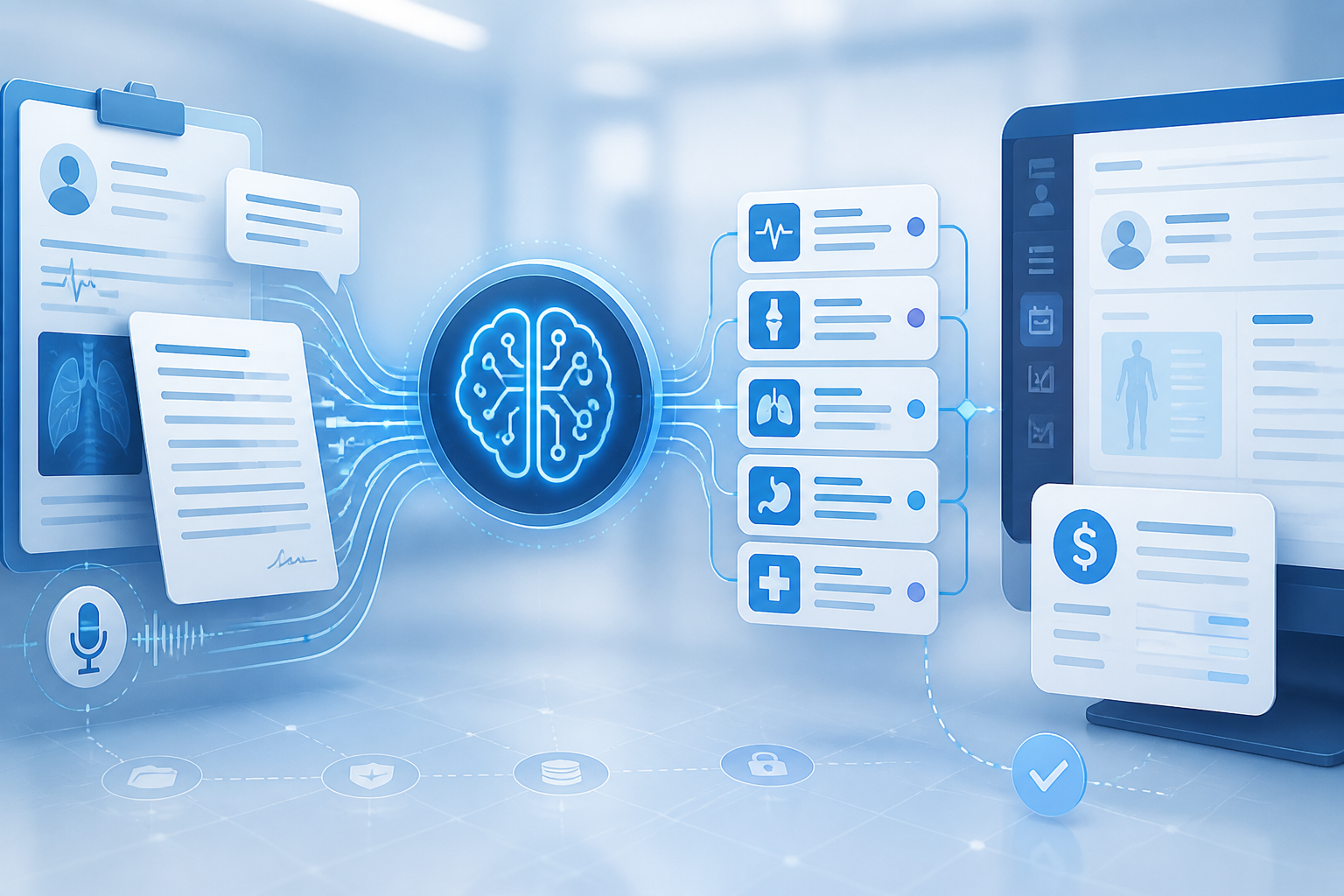
Oracle Health Puts AI Coding Suggestions Inside the EHR
Oracle Health’s Clinical AI Agent now suggests professional fee codes at the point of care — a sign coding AI is moving inside the EHR itself.
·
Oracle Health’s Clinical AI Agent now suggests professional fee codes at the point of care — a sign coding AI is moving inside the EHR itself.
·

Cardiology’s 2026 CPT set brought 288 new codes and 84 deletions across PCI, echo, and remote monitoring. Static rule engines can’t keep pace — here’s what agentic AI changes.
·

XiFin’s Series B investment in Notable Systems replaces OCR-based document intake with agentic AI. Here’s what that shift means for coders and denial-prone claims heading into 2027.
·

ModMed’s agentic RCM platform folds coding guidance into denial prevention and appeals — a sign that coding accuracy and revenue recovery are converging.
·

NCCI PTP edits version 32.2 took effect July 1, 2026 with roughly 4.4 million edit pairs. Static rule engines routinely miss the update window — here’s what that costs coders.
·

CMS’s newly released 2025 PEPPER for inpatient psychiatric facilities flags under- and over-coded claims — here’s what it means for coding accuracy and audit risk.
·

OIG’s Deistic Home Health audit found 37% of sampled claims failed billing, coding, or documentation rules. Here’s what automated coding validation would have caught.
·

CMS’s RAPID pathway can post a Medicare coverage decision the same day a device wins FDA authorization — but HCPCS codes and payment rules still take months to catch up.
·

CMS is mandating malnutrition quality reporting by 2028 while OIG audits keep finding malnutrition codes unsupported. Here’s what coders need to know.
·

CMS’s Q2 2026 HCPCS decisions add 15 new drug and biosimilar codes for October 1 and deny two closely watched revision requests.
·